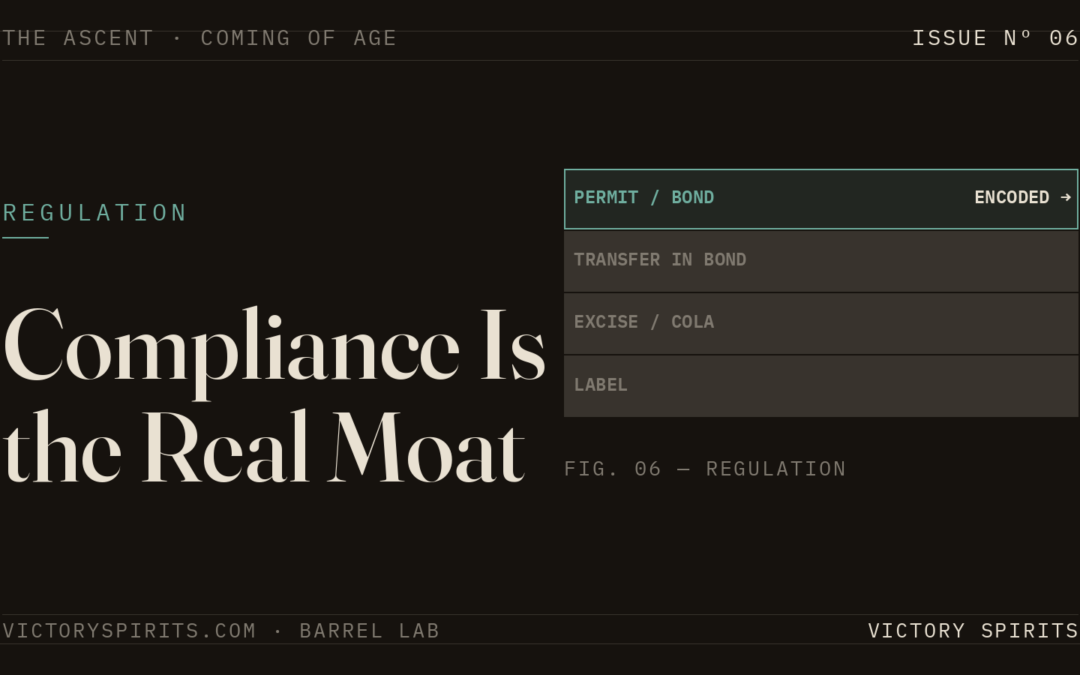
Compliance Is the Real Moat — and That Should Change
The federal framework around distilled spirits is genuinely hard.
That difficulty has protected incumbents for decades.
But a moat that exists only because the water is muddy is not a moat worth defending.

Ask why bulk whiskey stayed opaque long after every comparable market got a reference layer, and the honest answer is not conspiracy. It is compliance. Permitting, bonding, transfer in bond, label approval, formula approval, the excise machinery — the regulatory surface a barrel has to cross to move legally is real, intricate, and unforgiving of mistakes. It is the highest wall in the business, and for a long time the people who learned to climb it have owned the market on the other side.
That is a moat. The question this piece asks is whether it’s the kind of moat anyone should want.
The complexity is real — and it has been the business
None of this is imaginary difficulty. A distilled spirits plant operates under a federal permit with obligations most outsiders never see. Moving spirit between bonded premises without triggering tax requires doing it correctly, in the right sequence, with the right records. Getting a product to market means clearing label and, often, formula approval. The excise layer alone — who owes the tax, at what rate, at what moment — is enough to stall a newcomer indefinitely. The rules are knowable, but they are not obvious, and the cost of getting them wrong ranges from a stalled deal to a serious problem with the federal government.
For the operators who mastered this, the complexity was not an obstacle. It was the asset. If you understood transfer in bond and your counterparty didn’t, you could intermediate every transaction they couldn’t do themselves. If you knew the excise mechanics and they didn’t, the value of that knowledge accrued to you. The wall kept newcomers out, and the people already inside had every reason to keep it exactly as high and as opaque as it had always been. Nobody has to conspire to protect a moat that protects itself.
A moat made of mud drains
Here is the problem with a barrier built on complexity rather than genuine scarcity: it is only as durable as the confusion that sustains it. A moat around a castle is stone — it stays. A moat that is really just muddy water, hard to see through, drains the moment someone builds a bridge. Regulatory complexity is muddy water. The rules are not secret. They are published, static, and knowable. What kept them a barrier was not their content but their illegibility — the fact that navigating them required either years of accumulated experience or an intermediary who charged for the privilege.
Illegibility is a solvable problem. Rules that are knowable can be encoded. A process that required a specialist can be turned into a guided path. The moment the regulatory surface becomes navigable — the moment a qualified newcomer can understand what applies to them, in what order, without hiring their way through it — the moat stops protecting anyone. Not because the rules got easier, but because the confusion that made them a barrier got removed.
Compliance as infrastructure, not gate
The reframe is the whole point of this piece. Compliance can be a gate, admitting the few who already know the way and turning back everyone else. Or it can be infrastructure — a navigable layer that lets any qualified participant cross legally, correctly, and without an incumbent’s permission. Same rules. Opposite function.
Treating compliance as infrastructure does not mean lowering the standard. Nothing about making the regulatory path legible weakens the requirements — the permit still has to be held, the tax still has to be paid, the transfer still has to be done right. What changes is that meeting those requirements stops depending on privileged knowledge. The standard stays exactly as high; the arbitrary part — the part where you needed to already be inside to get inside — goes away. That is not deregulation. It is the opposite of a racket: the rules enforced for everyone, made accessible to everyone.
This is the same argument this series has made about price, about provenance, about the excise line. In every case the incumbency was built not on a better product but on an information gap, and in every case legibility closes the gap. Compliance is simply the largest gap of all, because it is the one with the force of federal law behind it, which is exactly why it protected so much for so long.
Who loses, and why that’s the right outcome
Be clear about who this disadvantages. It disadvantages the intermediary whose value was never the spirit or the service but the maze itself — the operator who monetized the fact that the buyer couldn’t do it alone. When the maze becomes a map, that value evaporates. That is not a market failure. It is a market correcting: value that existed only because of confusion returning to the people who were paying for the confusion.
What replaces it is a bigger market. Every qualified brand, blender, and buyer who was kept out by the wall rather than by the quality of their product is a participant the market didn’t have. Lowering the arbitrary barrier while keeping the real standard doesn’t cheapen the business — it grows it, and it moves the competition to where it belongs: the quality of what you make and how well you serve, not the height of the paperwork you happened to learn to climb.
The moat should be your product. It should never have been the forms. Turning the forms from a gate into infrastructure is how this market finally lets in everyone who actually belongs in it.
The Ascent — Coming of Age. A bi-weekly series on the structure and future of the bulk whiskey market, from the team building Victory Spirits Barrel Lab.