
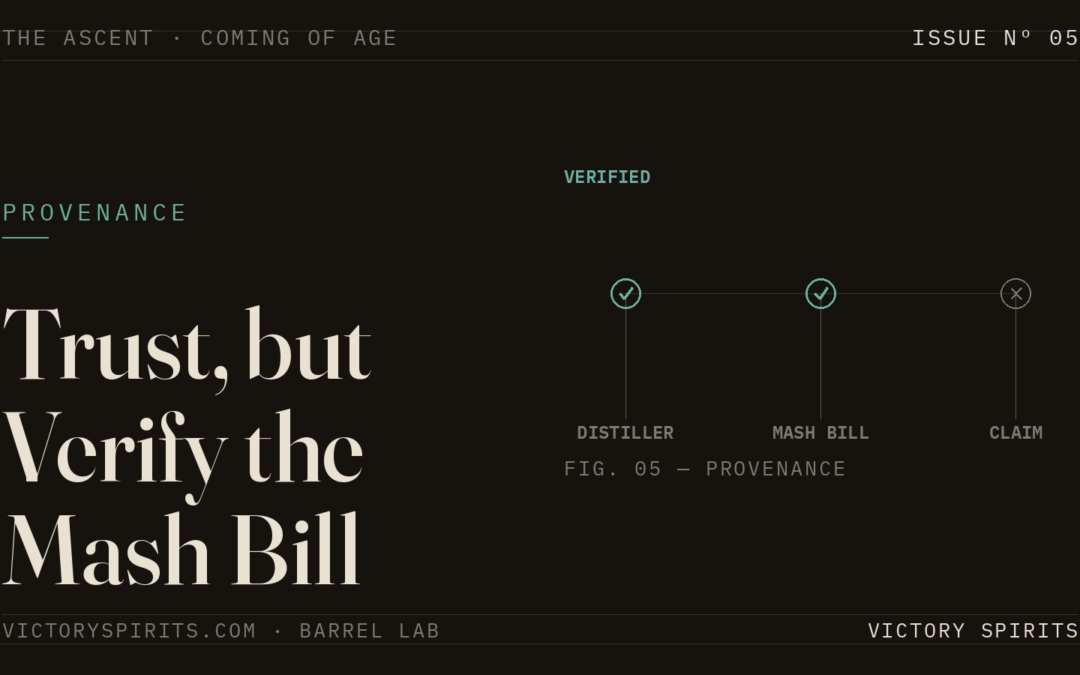
Trust, but Verify the Mash Bill
The mash bill is the load-bearing fact of a barrel deal — and the easiest thing in the transaction to assert and the hardest to check. That gap is where the seller has always lived.
Every barrel trade rests on a claim. This is an eight-year. It’s a high-rye from a known producer. The mash bill is seventy-five percent corn. Those claims determine what the barrel is worth, and in the market as it has run, most of them arrive unverified — asserted by the party who benefits from the assertion, accepted by the party with the most to lose if it’s wrong. The buyer takes the seller’s word, prices off it, and finds out whether it was true years later, if ever.
That is not a small problem at the edges of the market. It is the central mechanism by which value has been transferred in this business, and it has always run in one direction.
Provenance is the biggest lever, and the least checkable
We’ve argued in this series that provenance is the single largest driver of a barrel’s value — who distilled it, on what mash bill, at what plant, for how long. A confirmed eight-year from a recognized producer is simply a different asset than an eight-year taken on faith, and the price reflects it. Which means the most valuable fact about a barrel is also the one most vulnerable to overstatement, because the entire premium rides on information only the seller reliably holds.
Think about what the seller knows that the buyer does not. The seller knows the true fill date, not the rounded-up one. The seller knows whether “high-rye” means the mash bill the buyer is imagining or something looser. The seller knows if the barrel’s stated producer is the actual distiller or a convenient attribution. The buyer knows what he was told. Every one of those gaps is either a margin the seller captures or a risk the buyer absorbs, and in an opaque market the gaps are the business model.
The failure modes are ordinary, not exotic
This is rarely fraud in the dramatic sense. It is the accumulation of small, self-serving imprecisions that a market without verification never corrects. Age gets rounded generously. A barrel gets attributed to the better-known distillery in a shared lineage rather than the one that actually made it. A mash bill gets described in round terms that flatter it. A claim of “bottled-in-bond eligible” gets made about spirit that categorically isn’t. A stated mash bill doesn’t even sum to a hundred percent — and no one checks, because checking was never part of the deal.
None of these require a villain. They require only an environment where the claim is worth money and the verification is optional. Remove the verification and the claims drift, reliably, in the direction that helps whoever is selling. That drift is not noise. It is a structural tilt, and the buyer pays for it every time.
Verification is what turns a claim into a fact
The phrase, borrowed and worn, is exactly right for this market: trust, but verify. For most of its history the trade had only the first half. Trust was the whole instrument — you dealt with people you knew, and the relationship was the guarantee. That worked at the scale of a few known counterparties. It does not survive contact with a market of hundreds of producers and thousands of barrels, where the person on the other end is not someone you’ve traded with for twenty years.
Verification is the second half, and it is what a reference layer actually adds. It means the mash bill is checked against records, not accepted from a listing. It means age is tied to a documented fill date, not a seller’s memory. It means the producer attribution follows a consistent rule rather than the most flattering available option. It means the transfer and gauging documentation travels with the barrel, so its history is legible rather than asserted. And it means a mash bill that doesn’t sum to a hundred is rejected before it ever reaches a buyer, because a market with integrity does not pass along claims that fail on their face.
This is not about assuming bad faith. Most sellers are honest. The point is that a market should not require the buyer to bet on it. When verification is built into the structure, honesty stops being something the buyer hopes for and becomes something the system guarantees — which protects the honest seller too, because in a verified market his true eight-year is no longer competing against someone else’s optimistic one.
Integrity is a feature of the market, not a favor from the seller
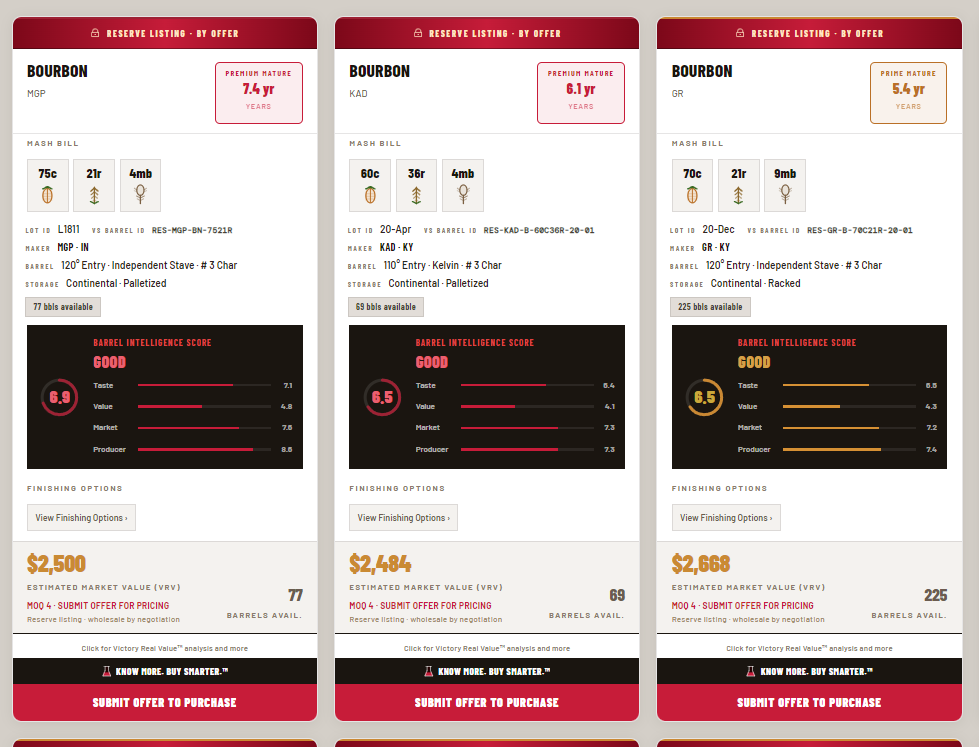
Every listing in Barrel Lab™ has extensive detail, verified fill dates, mash bill, provenance, exclusive Barrel Intelligence Score™, Verified REAL Value™, predictive finishing outcomes, flavor profiles, barrel yield estimates and more.
The deepest shift here is about where trust lives. In the opaque market, trust was personal — you extended it to a counterparty and hoped. In a legible market, trust is structural — it lives in the verification layer, and it applies to every barrel regardless of who is selling it. That is a far more powerful thing, because it does not depend on the buyer already knowing whom to believe.
A barrel with checkable provenance is an asset. A barrel with an unverifiable story is a bet dressed up as an asset. The difference between them has always existed; what’s changed is that it no longer has to stay hidden until it’s too late to matter. The mash bill can be a fact instead of a hope. In a market that has run on the seller’s word for its entire history, that is not a small improvement. It is the whole game, corrected.
The Ascent — Coming of Age. A bi-weekly series on the structure and future of the bulk whiskey market, from the team building Victory Spirits Barrel Lab.