
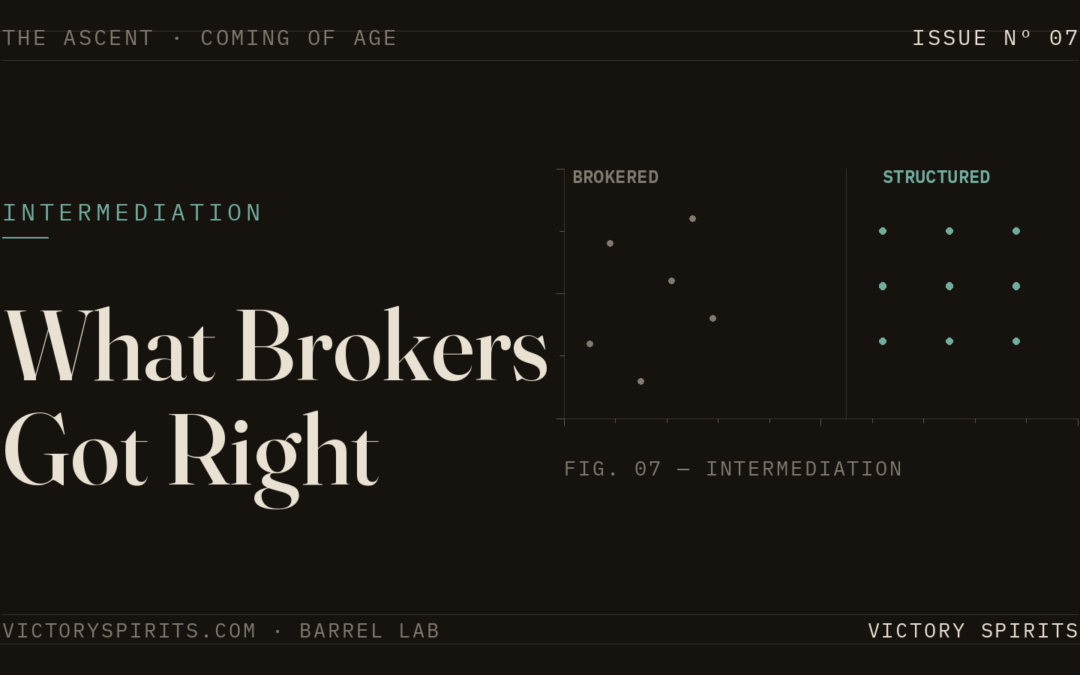
It’s easy for a marketplace to cast the broker as the villain of an opaque market. That’s lazy, and it’s wrong. Brokers built the only market there was. The question isn’t whether they had value — it’s where that value belongs as the market gets a structure.
A platform arguing for transparency has an obvious temptation: to tell the story where the broker is the problem, the gatekeeper hoarding information, the middleman to be disintermediated. It’s a satisfying story and it’s a false one. For most of this market’s history the broker wasn’t the obstacle to a functioning market — the broker *was* the functioning market, the only mechanism connecting spirit that needed to move with buyers who needed it. Before you argue for what comes next, you owe an honest account of what they got right.
They made a market where none existed
Start with the largest thing. In the absence of any exchange, any listing service, any reference price, barrels still had to find buyers — and brokers made that happen through nothing but knowledge and relationships. They knew who was sitting on surplus and who was short. They carried in their heads a map of the market that existed nowhere on paper. When a producer needed to move inventory, the broker knew which three buyers might actually want it. That is market-making in its oldest and purest form, done without any infrastructure to lean on, and it kept spirit moving for decades in a business that had no other way to do it.
Relationships carry things structure can’t
The broker’s second contribution is subtler and doesn’t disappear with a platform: trust, vouched personally. When a broker brings a buyer a deal, he’s putting his own credibility behind it. He’s known the seller for years. He can say, quietly, that this producer’s barrels are what they claim to be, or that this buyer pays on time and doesn’t renege. That kind of trust — earned over repeated dealings, backed by reputation — is a real asset, and it does work that a database entry cannot. Relationships also carry judgment: a good broker knows that a particular buyer’s program actually needs a particular profile, and makes a match that no keyword search would surface. That is curation, and it has genuine value.
They also take on risk and friction that nobody thanks them for — smoothing a deal when a shipment slips, holding a relationship together through a disagreement, reading a situation and knowing when to push and when to wait. These are human skills, and they matter most exactly when a transaction is complicated or something goes wrong.
Where the model strains
All of that is real. And all of it runs into the same ceiling: it does not scale, and it does not share.
A broker’s market is the size of his relationships. He can only know so many producers, cover so many buyers, hold so much inventory in his head. In a scarcity market that was enough, because the whole game was access and there wasn’t that much to track. In a surplus market — inventory scattered across hundreds of plants, more barrels than any one network can map — the relationship model leaves most of the market invisible to most of its participants. The right buyer and the right barrel often never find each other, not because no broker could have made the match, but because no single broker knew both sides.
And because the broker’s knowledge is personal, it stays siloed. The price he strikes is private. The comparable he knows about doesn’t inform anyone else’s deal. Every transaction happens in its own pool of information, which is precisely the opacity this series keeps returning to. The strength of the model — knowledge held in a trusted person’s head — is also its limit, because a head is not a market.
Structure raises the floor; judgment moves up
The future isn’t broker versus platform. It’s judgment on top of infrastructure, and that framing matters because it tells you what each is actually for.
A platform is very good at the commodity layer — the part of the work that is matching, price reference, verification, and compliance. Those are exactly the tasks that benefit from scale, consistency, and shared information, and exactly the tasks that exhaust a broker’s time without using his best skills. When structure handles that layer, it doesn’t eliminate the broker. It frees him. The grunt-work of finding who has what, checking what it is, and running the paperwork gets absorbed by infrastructure, and the broker is left to do the thing only he can do: apply judgment, carry relationships, curate the complicated deal, vouch for the counterparty a database can’t vouch for.
That is a better business for the good broker, not a worse one. The intermediary whose only value was knowing who had inventory — the pure information arbitrage — loses ground, and should, because that value was really just opacity in human form. But the broker whose value is judgment and trust moves *up* the chain as the floor rises beneath him. He spends his time where he’s irreplaceable instead of where he’s merely necessary.
The honest version of the future
Markets that get a reference layer don’t kill their intermediaries. They reorganize them. The floor tasks get systematized; the human tasks get more valuable, not less, because they’re no longer buried under the mechanical ones. The best brokers in this business will do better in a transparent market than they did in an opaque one, because transparency takes the part of their job that was drudgery and asymmetry and leaves them the part that was skill.
What brokers got right was everything about making a market out of relationships when there was nothing else to make one from. What comes next doesn’t erase that. It builds the infrastructure that should have been under them all along — and lets the good ones finally stand on top of it.
—
*The Ascent — Coming of Age. A bi-weekly series on the structure and future of the bulk whiskey market, from the team building Victory Spirits Barrel Lab.*