
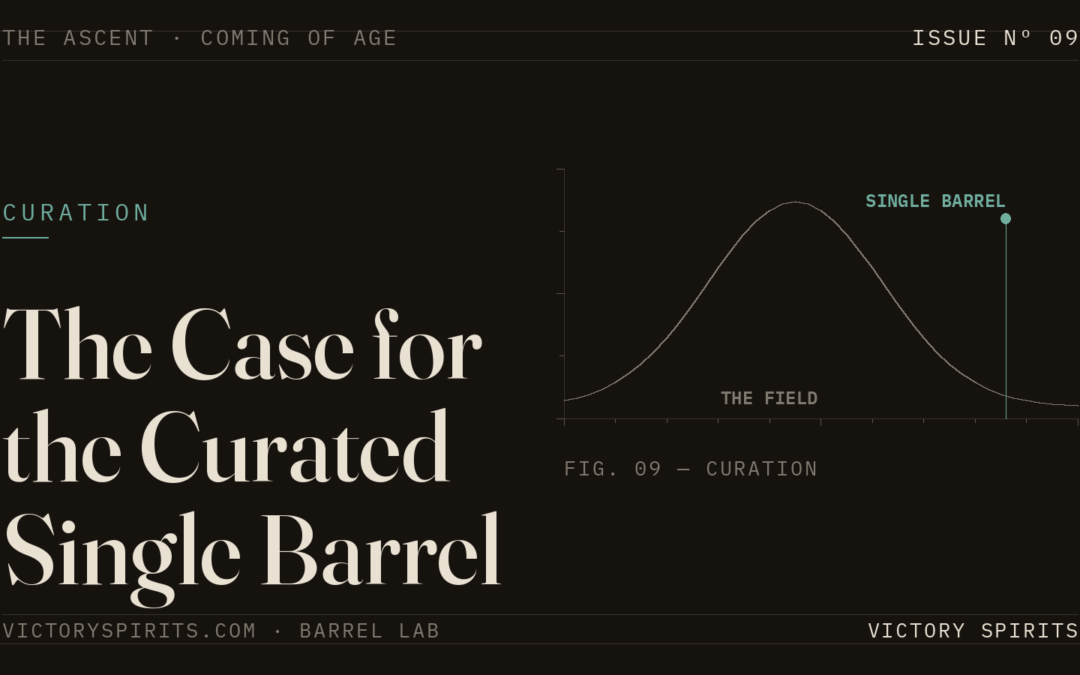
In a commodity market, individuality is a defect to be blended away. In a single barrel, individuality is the entire product. As the surplus makes the commodity cheap, the curated single barrel is how you climb back out of it.

Most of this market treats a barrel as a unit of a fungible thing 62 proof gallons of a certain profile, priced against everything comparable, valuable precisely to the degree it resembles its peers. That’s the commodity frame, and it’s the right frame for most of the inventory most of the time. But it misses a category where the logic inverts completely: the single barrel, where the thing that makes a barrel *different* from its peers is not noise to be averaged out but the whole reason someone will pay a premium for it.
Understanding that inversion matters more now than it used to, because the surplus is about to make it the most interesting play in the business.
A blend exists to erase variation — to take many barrels and produce one consistent, repeatable profile. That’s a real skill and a real product. But it’s also, by design, the opposite of scarcity: the point of a blend is that there’s more of it, reliably, forever. The single barrel is the other thing entirely. It is finite by definition — one barrel, a few hundred bottles, and when they’re gone they’re gone. It carries a specific character that came from one set of staves, one position in one warehouse, one particular path through maturation. And it comes with a story that is true rather than manufactured: this spirit, from this place, aged exactly this long, bottled as itself.
Consumers pay for that. They pay for the finitude, the specificity, the sense that they’re getting something particular rather than something produced to a spec. In a market drowning in consistent product, the barrel that is unapologetically *itself* is the one with pricing power.
To sell the specific, you have to know the specific
Buyers will find a selection of unique–one of one–barrels listed. Unique mash bills, heirloom ingredients–no barrel will be the same.
Here’s the catch, and it’s where this piece connects to everything else in the series. You cannot sell individuality you can’t document. The entire premium of a single barrel rests on the buyer believing — and being able to verify — that this barrel really is what it claims: this producer, this mash bill, this age, this character. Strip away verifiable provenance and a “single barrel” is just a bulk barrel with a better adjective. The story only commands a premium if the story is true, and true in a way someone can check.
Which means curation depends on exactly the legibility this series has argued for throughout. The data that makes a commodity market fair — provenance you can verify, maturity you can measure, a character you can actually describe from fact rather than marketing — is the same data that makes a single-barrel program credible. You need to know the specific to sell the specific. The reference layer that keeps the seller honest on a bulk trade is what lets a curator tell a premium story without lying. Transparency and premiumization are not in tension here. Transparency is the precondition for premiumization done honestly.
Protecting the artisan from the commodity frame
There’s a particular injustice the commodity frame commits, and curation corrects it. A small distiller with genuine provenance — a real place, a real method, a distinctive spirit — gets flattened when the only way the market knows how to value a barrel is by comparison to the nearest commodity comp. Priced purely against bulk, the artisan barrel looks overpriced, because the comp set doesn’t capture what makes it worth more. The market’s own machinery erases the very quality that should command the premium.
A curatorial approach refuses that flattening. It says some barrels should be valued for what makes them distinct, not penalized for lacking an exact commodity comparable — that the absence of a peer is sometimes the point, not a data gap. Protecting the artisan barrel from being priced as a commodity is not sentimentality; it’s accuracy. The distinctive barrel really is worth more, and a valuation that can only see commodity resemblance is simply wrong about it. Curation is, in part, the discipline of valuing the specific correctly instead of forcing it into a frame built for the fungible.
Storytelling that rests on fact
The reflex objection to “storytelling” in whiskey is that it’s marketing — a romance layered over spirit to justify a price. Sometimes it is. But the difference between a story that’s fluff and a story that’s value is entirely whether it’s grounded in verifiable fact. “Aged in a distillery that no longer exists” is marketing if it’s vague and value if it’s documented. “A distinctive high-rye character from a specific producer” is fluff if it’s asserted and premium if it’s provable. The data doesn’t kill the romance. It underwrites it. A verified provenance is what turns a story from a liberty taken into an asset owned.
Where value goes when the commodity gets cheap
Bring it back to the surplus. When abundant inventory pushes commodity margins down — and it will — value doesn’t disappear from the market. It migrates. It concentrates in the places the surplus can’t erode, and the curated single barrel is exactly such a place, because its value was never about being one more unit of a plentiful thing. Its value is finitude, specificity, and a true story, none of which a glut touches.
So the surplus and the single barrel are two halves of one strategic picture. The surplus makes the commodity cheap and the matching problem urgent — that’s the volume game, and it’s real. But the way *up*, the way a brand or a buyer climbs out of competing on commodity margin, runs through curation: sourcing the distinctive barrel, verifying what makes it distinctive, and selling that specificity honestly. The same legible market that makes the commodity trade fair is what makes the curated trade possible. One market, two heights– and the curated single barrel is the higher one.