
The Long Way Back · Part 5 of 5
Holding to 2030: The Owner's Playbook
Waiting costs about $65 a barrel a year. Against the spread between a forced bid and fair market value, that is small. Here is the math, by cost basis, and the four rules for the wait.
Waiting costs about $65 a barrel a year in cash once the whiskey is past four years old, plus the whiskey the angels take.
That is the number to weigh against a forced-sale bid, and for most cost bases it is small next to the spread between the forced tier and fair market value described in Part 4. The inputs are real 2026 rates. Kentucky storage with insurance now averages $3.75 a barrel a month for whiskey up to four years old and $5.00 a month for barrels over four, which is where every barrel in the table below sits for the whole hold. Add Kentucky's ad valorem barrel tax at the 2025 industry average ($75 million across 17.1 million barrels, about $4.40 a barrel) and evaporation at 3% of volume a year, a rule of thumb that runs higher on hot upper floors and lower in palletized ground-level storage. Your own warehouse rate replaces the first line.
| Cost basis per barrel | Cash carry per year (age 4+) | Cash carry, 4 years to 2030 | Evaporation, 4 years (in kind) | Break-even sale price in 2030 |
|---|---|---|---|---|
| $600 | $64 | $258 | 11% of volume | $970 |
| $900 | $64 | $258 | 11% of volume | $1,310 |
| $1,200 | $64 | $258 | 11% of volume | $1,645 |
| $1,500 | $64 | $258 | 11% of volume | $1,985 |
| $1,800 | $64 | $258 | 11% of volume | $2,325 |
Break-even here means recovering cost plus carry on the whiskey that remains, with no return on capital. A 2022 fill bought at $1,200 needs about $1,645 a barrel as an eight-year-old in 2030. Today's forced-sale bid for the same barrel is well under $1,200. Today's fair-market comp for a seven- to eight-year-old with a standard mash bill is well above $1,645. The risk is that a 2022 fill turns eight in 2030 alongside the largest eight-year-old cohorts Kentucky has ever produced (Part 3), so today's comp is not guaranteed to hold. The decision is whether the owner can fund about $65 a year, and whether the barrel has a buyer or a bottle waiting when it gets there.
Four rules for the wait
- Do not sell into a forced-sale bid. The gap between fair market value and forced liquidation now exceeds the barrel's entire appreciation since fill. Time is the only lever that closes it. If cash is the problem, a barrel-backed loan against fair market value costs less than the discount a receiver's buyer will take.
- Hold the barrels with more than one buyer. Barrels with a standard mash bill, verified provenance and several possible bottlers trade like a commodity with a floor. Barrels with one buyer trade like Uncle Nearest's. If you own both kinds, the second kind is the one to move first, and to move on your timeline, not a lender's.
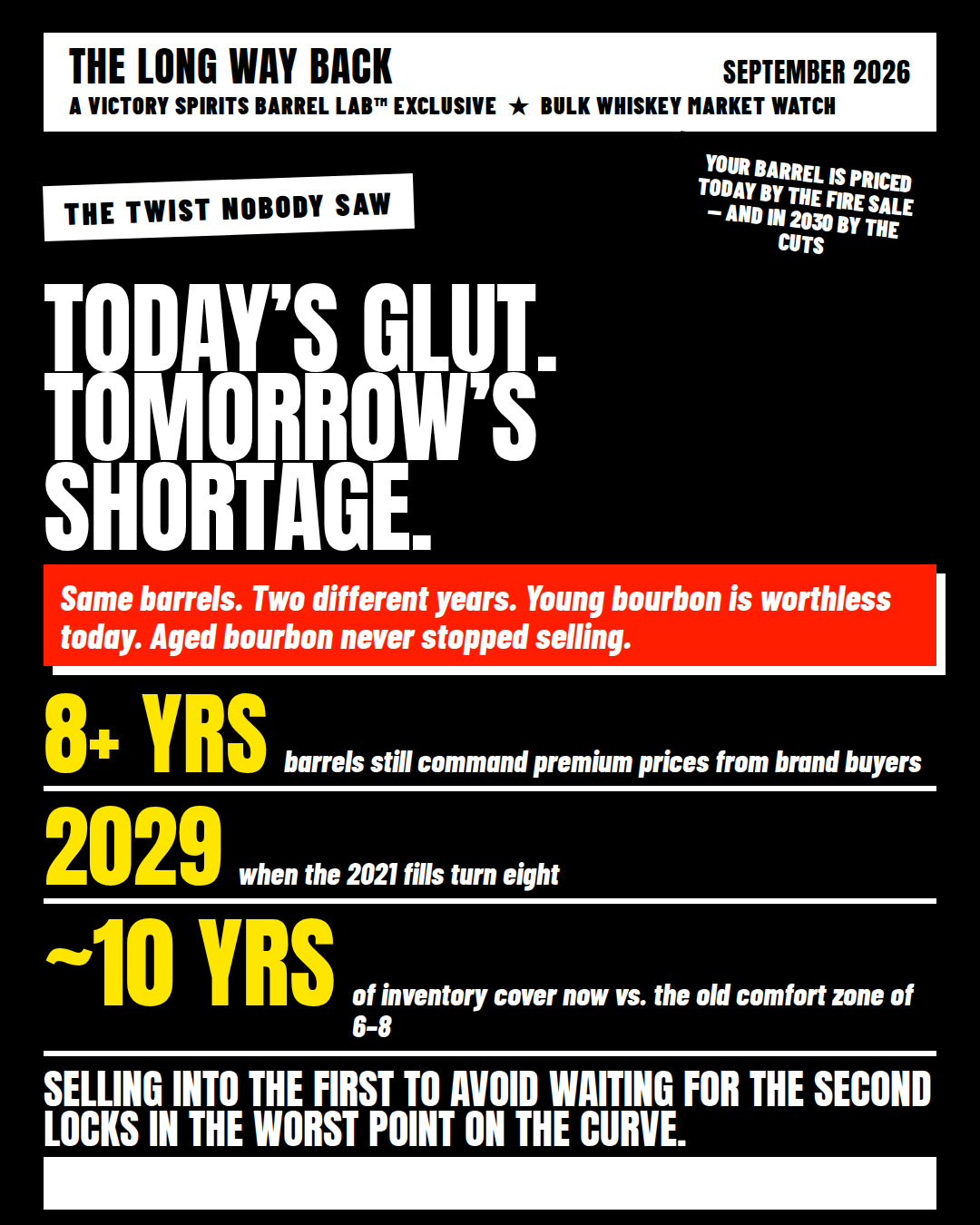
- Model to age eight, not to the next quarter. The asset that still commands a premium is an 8+ year barrel with a brand offramp. A 2021 fill becomes that asset in 2029; a 2022 fill in 2030. Only 3% of Kentucky's inventory is there today, but expect company: the biggest fill years on record turn eight from 2029 through 2032. The 2025–2026 cuts thin the pipeline only after that, in 2033 and 2034.
- Bottling is the exit that does not need the bulk market. Private label and single-barrel programs convert a bulk asset priced at cost into a finished good priced at retail. With the bulk market not back in balance until the 2030s, it is the only route whose timing the owner controls, and it is the reason Barrel Lab™ pairs every listing with a path to a co-packer, a label and a route to market.
What would change this view
A trade settlement that restores Canadian and EU volume is the single biggest lever. A cut in fills to around 1 million barrels a year is the other; without it, inventory does not fall at all. A further step down in the drinking rate below 54% pushes everything back. Watch the 2021 through 2023 cohort: it is three to five years old now, in the tier that clears at cost, and it turns seven to nine in 2028 through 2032. That is the window this series has been about.
The bulk market will stabilize in stages. The forced-sale tier clears in 2026 and 2027. The biggest crop of eight-year-olds arrives from 2029 through 2032, and real scarcity of old whiskey in 2033 and 2034. Total inventory returns to normal around 2033 if exports recover, and closer to 2040 if they do not. Everything a barrel owner decides between now and then should be decided with those dates in view, and with an exit that does not depend on the last one.
The consolidated analysis, all charts and every source are in the whitepaper, When Will the Glut End?
What are your barrels worth in an orderly market?
Barrel Lab™ lists bulk spirits in the barrel with verified provenance and a real value, not a fire-sale bid. Licensed buyers enter with a DSP permit.
Enter Barrel LabBarrel Lab™ researched, charted, and drafted this with AI for the people who own the barrels. Every number traces to a source you can open. We think that is how brands should use these tools: to do the work faster and show it, not to make things up.