

The Long Way Back · Part 4 of 5
What a Barrel Is Worth in a Forced Sale
The same barrel has three prices right now. The spread between the first and the third can exceed everything the barrel has earned since it was filled.
Ask what a barrel of four-year-old Kentucky bourbon is worth today and you will get three honest answers, and they can be a thousand dollars apart.
Venture First, which performed 42 valuations covering 555,000 barrels in 2025, lays out the three standards plainly. Fair market value is what a barrel should fetch between a willing buyer and a willing seller, neither under compulsion, with reasonable time. Orderly liquidation value is what the same inventory yields in a controlled wind-down, net of the cost of getting it sold. Forced liquidation value is what it yields when the timeline is compressed and the buyer pool knows it.
| Basis | Who sets it | Where it sits today (young bourbon, 2–5 yr) |
|---|---|---|
| Fair market value | Brand buyers, orderly bulk trades, VRV | At or modestly above cost to produce |
| Orderly liquidation | Lenders, workouts, broker-run sales | Below cost |
| Forced liquidation | Receivers, bankruptcy court | Well below cost; new-fill trading around $450 a barrel |
Venture First's finding, and the single most important fact for anyone deciding whether to sell this year, is that the spread between fair market value and forced-sale pricing "can now exceed the entire appreciation a barrel has earned since it was filled." In plain terms: a barrel bought new-fill in 2022 and sold in a forced sale today can return less than it cost, even though the whiskey inside it is four years better than the day it was bought.
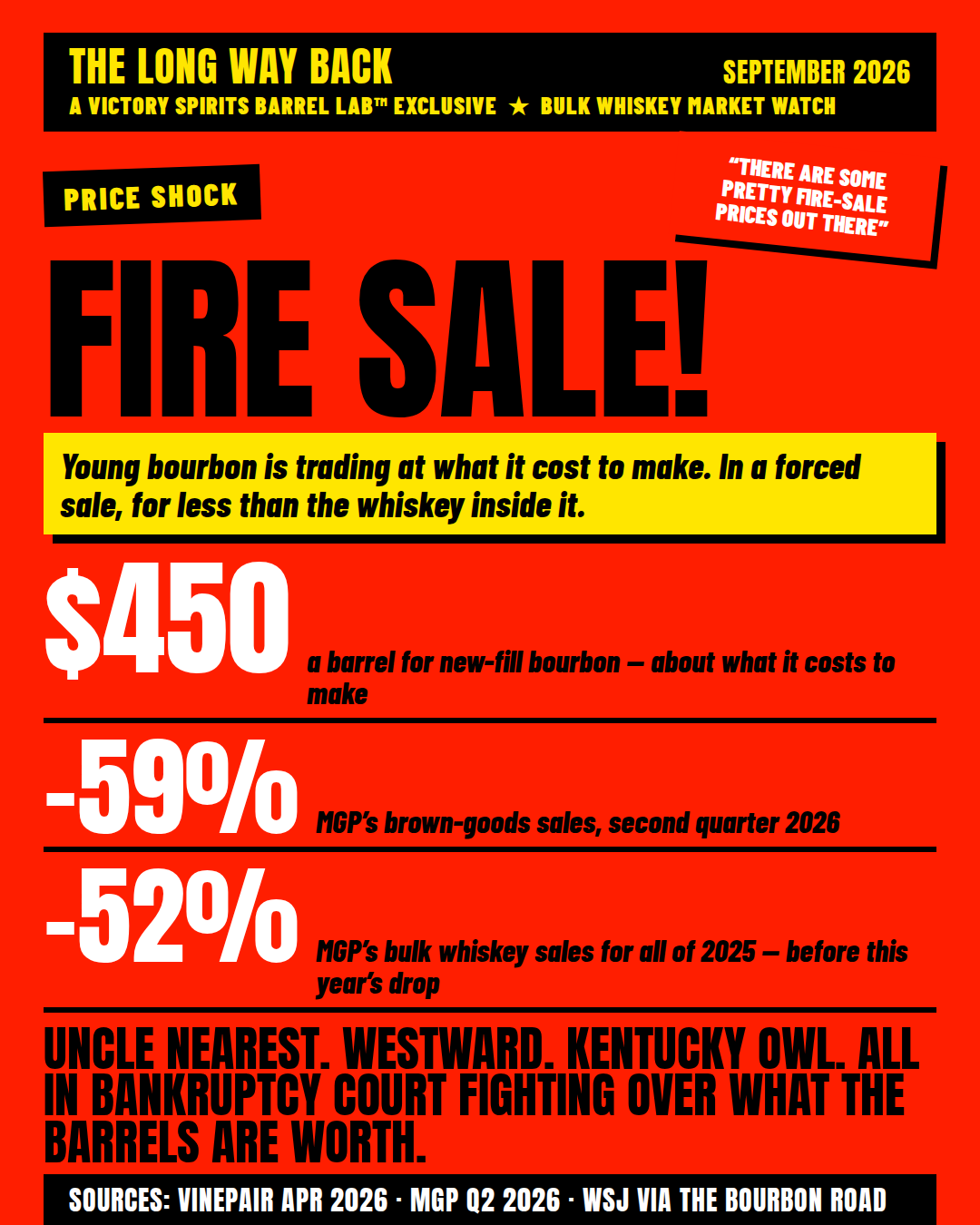
The forced tier is what the headlines quote, and there is plenty of it. MGP, the largest bulk supplier in the country, reported brown-goods sales down 59% in the second quarter of 2026 on top of a 52% decline for all of 2025. Uncle Nearest, Westward and Kentucky Owl have all been in bankruptcy court arguing with lenders over what their barrels are worth, and court-supervised sales move barrels on the compressed timeline that defines forced liquidation. Independent bottlers describe "some pretty fire-sale prices out there." New-fill bourbon changes hands near $450 a barrel, close to what it costs to make.
What the headlines leave out
The forced tier is a young-whiskey tier. Venture First's transaction data shows 8+ year barrels still commanding premium prices from brand buyers even as the broad middle clears at cost. Look at the age profile of Kentucky's inventory and the reason is obvious: only 3% of it, about half a million barrels, is older than eight years. That is not a glut. That is the scarcest thing in the state.
So the market is running two prices at once. Age no longer raises the floor, because there is so much two-to-five-year-old whiskey that any of it with a deadline attached trades at the forced tier. But age still raises the ceiling, because a brand that needs an eight-year-old barrel for a release cannot substitute a four-year-old, and there are very few eight-year-olds to bid on. The market is not saying bourbon is worthless. It is saying young bourbon with no obvious home is worthless today, and paying up for proven age with a path to a bottle.
Three practical consequences follow.
- Exposure time is now the biggest single driver of price. Every month a seller can give a barrel to find its buyer moves it up a tier. A lender's model calibrated to recent forced trades will read lower than fair market value; that divergence is real and should be discussed openly, not papered over. Our own VRV is built to state what a barrel should fetch in an orderly market, deliberately excluding cost-basis dumps and distress sales, which is why it reads above the tape right now.
- Barrels with one buyer trade like Uncle Nearest's. Barrels with many buyers trade like a commodity with a floor. A standard mash bill from a known producer, verified provenance and a clean chain of custody means several possible bottlers. A single brand's niche mash bill means one, and in a forced sale that buyer sets the price.
- A forced sale is a decision about time, not about whiskey. The only thing that moves a barrel from the third price to the first is the seller's ability to wait. What waiting costs, and for which barrels it pays, is Part 5.
Next: Holding to 2030 — the owner's playbook.
What are your barrels worth in an orderly market?
Barrel Lab™ lists bulk spirits in the barrel with verified provenance and a real value, not a fire-sale bid. Licensed buyers enter with a DSP permit.
Enter Barrel LabBarrel Lab™ researched, charted, and drafted this with AI for the people who own the barrels. Every number traces to a source linked in the whitepaper. We think that is how brands should use these tools: to do the work faster and show it, not to make things up.