

The Long Way Back · Part 1 of 5
The Glut Is Real. So Is the Gap.
Record inventory, consumption off its peak, fills cut hard, prices at cost. The two facts everyone argues about are the same barrels seen from two different years.
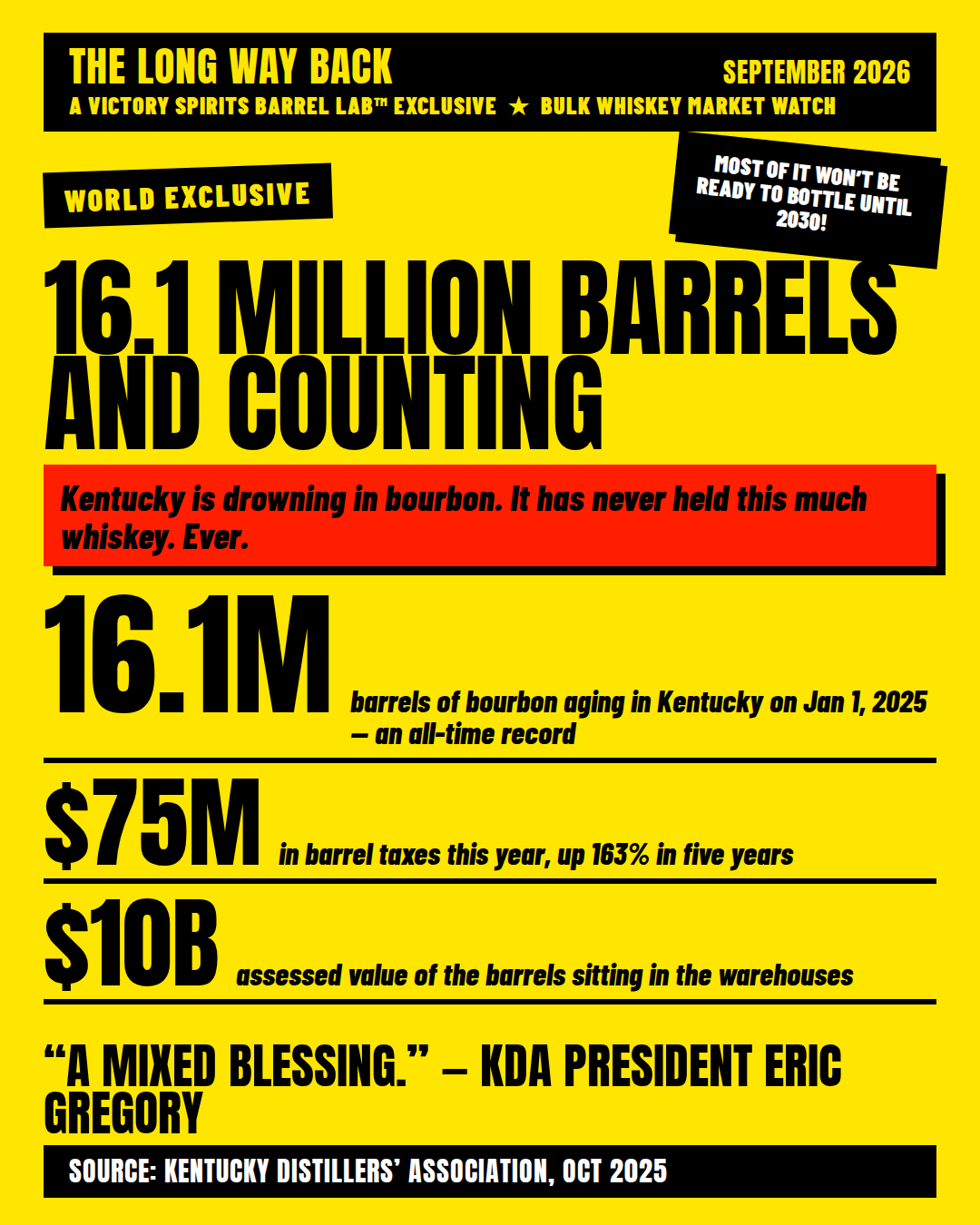
On the first day of 2025, Kentucky warehouses held 16.1 million barrels of aging bourbon, the most in the state's history, and a million more barrels of other spirits beside them.
The Kentucky Distillers' Association called it a mixed blessing and put a number on the burden: $75 million in barrel taxes for the year, up 163% in five years, on inventory now assessed at $10 billion.
That is the supply side of the story in one chart. The demand side takes two sentences. Americans bought 30 million nine-liter cases of American whiskey in 2025, down 1% on the year and 4% off the 2022 peak. And the share of American adults who drink at all has fallen to 54%, the lowest Gallup has measured since it started asking in 1939, and it stayed there in 2026.
Between those two facts sits the bulk whiskey market, and right now it is not a pretty place. New-fill bourbon trades around $450 a barrel, which is close to what it costs to make. MGP, the largest bulk supplier in the country, reported brown-goods sales down 59% in its second quarter, on top of a 52% decline for all of 2025. Independent bottlers describe "fire-sale prices." Uncle Nearest, Westward and Kentucky Owl have all been through bankruptcy court arguing with lenders about what their barrels are worth.
Producers have already answered the surplus with the sharpest cuts in modern memory. Kentucky filled a record 3.2 million barrels in 2023 and 3.03 million in 2024. Venture First, which valued 555,000 barrels last year, puts the 2025 cut at 28% and 2026 at another 20% or more, taking output back to roughly 2017 levels. Jim Beam idled its Clermont campus for all of 2026. Heaven Hill is rolling back production. Cooperages are sitting on unsold barrels.
Cuts of that size do two things. In the short run they do nothing for price, because the whiskey already in the warehouse is what sets the bid, and the whiskey filled in 2021 through 2024 is now two to five years old, the exact age that clears at replacement cost. In the long run they change everything, because the barrels that are not being filled in 2025 and 2026 are the seven- and eight-year-old barrels that will not exist in 2032 and 2033.
Now the number that should be on every barrel owner's wall. KDA's February 2026 economic report says more than 70% of Kentucky's inventory, 11.4 million barrels, was produced in the past four years. Only 3% is older than eight. The glut is a glut of young whiskey. Meanwhile the older end of the curve never broke: Venture First's transaction data shows 8+ year barrels still commanding premium prices from brand buyers even as the broad middle clears at cost. Age no longer raises the floor, but it still raises the ceiling.
That is the tell. The market is not saying bourbon is worthless. It is saying young bourbon with no obvious home is worthless today, and it is paying up for the thing that is scarce: proven age with a path to a bottle.
Which gives us two different questions that usually get asked as one.
When does the fire sale end? When the distressed inventory is gone. Receiverships and lender workouts move barrels on a compressed timeline to a buyer pool that knows it. Most of that supply clears in 2026 and 2027. Until it does, it sets the price for everything near it on the age curve.
When does the market balance? When annual fills fall below annual withdrawals and inventory drifts back toward six to eight years of cover instead of ten. Even after the cuts, fills are still running a little above withdrawals, so the pile has not started to shrink yet. Getting back to normal takes fills near 1 million barrels a year and a recovery in demand; that lands in the 2030s, and Part 3 has the math. Exports are the swing factor: Canada's delisting of American spirits and the tariff overhang took real volume off the table, and a reversal would pull the date forward.
For an investor holding barrels bought at 2022 prices, the honest read is this: your barrel is priced today by the fire sale, and it will be priced in the 2030s by the fill cuts. Selling into the first to avoid waiting for the second locks in the worst point on the curve. The rest of this series is about what it costs to wait, which barrels are worth waiting on, and the one exit that does not depend on the bulk market at all.
Next: Who Is Drinking Bourbon in 2036?
What are your barrels worth in an orderly market?
Barrel Lab™ lists bulk spirits in the barrel with verified provenance and a real value, not a fire-sale bid. Licensed buyers enter with a DSP permit.
Enter Barrel LabBarrel Lab™ researched, charted, and drafted this with AI for the people who own the barrels. Every number traces to a source you can open. We think that is how brands should use these tools: to do the work faster and show it, not to make things up.