
Every other asset class has a number you can check.
Whiskey has a phone call.
Here is what it would take to fix that.

Ask three people what a barrel of four-year MGP high-rye is worth and you will get three answers, each delivered with total confidence and none of them checkable. The seller’s number reflects what he paid and what he needs. The broker’s number reflects what he thinks he can get. The buyer’s number reflects what he was quoted the last time he asked, which may have been a year ago and a different barrel. There is no fourth number — no neutral reference the three of them can turn to and agree the trade is fair.
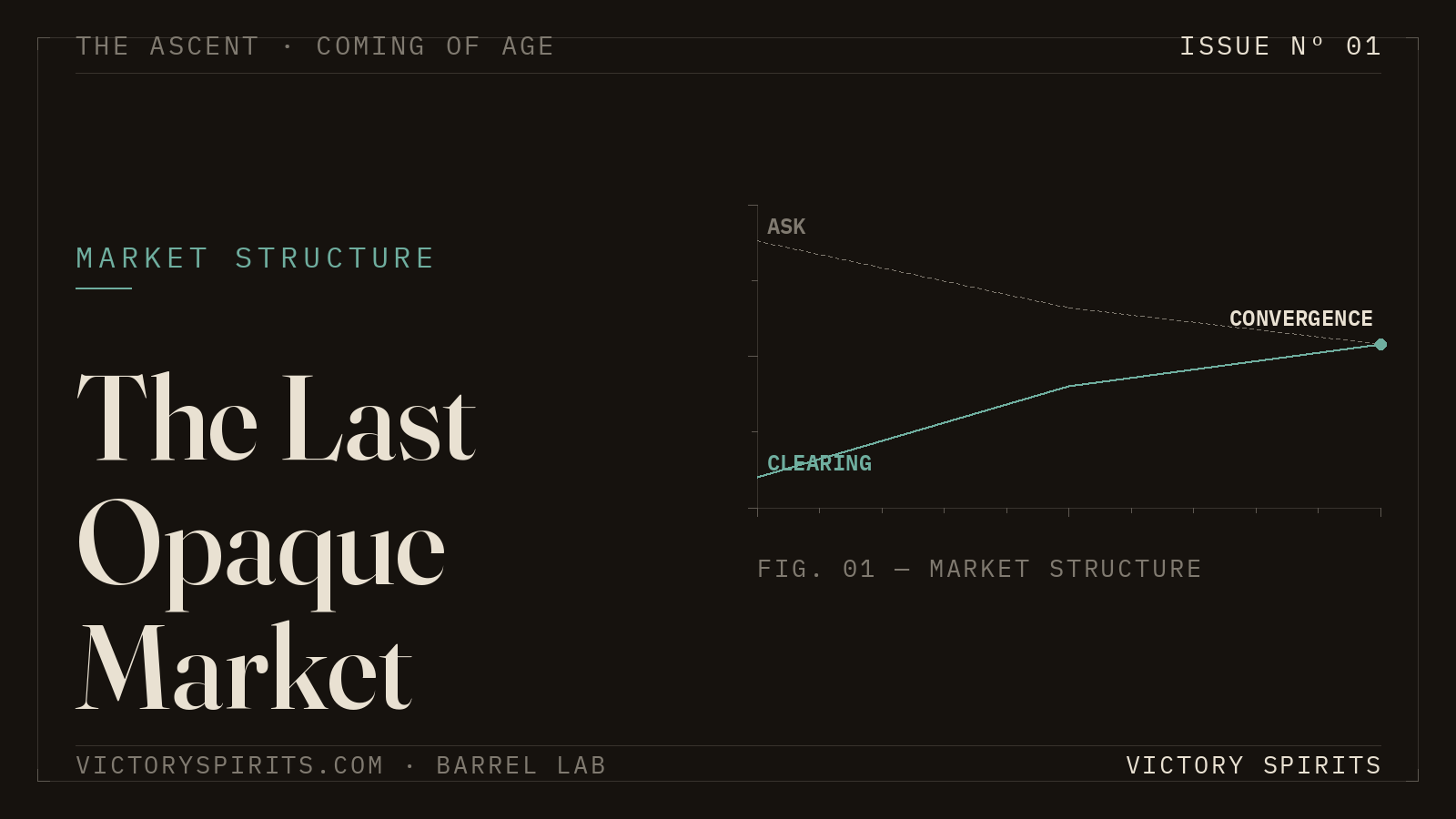
In the last issue we argued that bulk whiskey is the final commodity market still run on phone calls and asymmetry. The valuation problem is the center of that argument. Price is the single piece of information every transaction depends on, and it is precisely the piece this market has never made legible. So it is worth asking the question directly and seriously: what is a barrel actually worth, and what would it take to know?
Why ” what did it sell for ” the wrong starting point
The instinct is to price a barrel off comparable sales — find what similar barrels traded for recently and anchor to that. It is the right instinct and it is not enough, for a reason specific to this market: the comparable sales are mostly invisible. Private deals close without a public record. The prices that do circulate are asking prices, not clearing prices, and the gap between the two is exactly the asymmetry we are trying to eliminate. Building a valuation on whispered comps is building on sand.
A barrel is also not a fungible unit the way a share of stock is. Two barrels filled the same day at the same distillery can diverge in value over years of aging based on warehouse position, proof, evaporation, and the simple lottery of the wood. “What did a barrel sell for?” is the wrong question. “What is this barrel worth, given everything that makes it specific” is the right one — and that requires structure, not anecdote.
The inputs that actually move value
Strip the mystique away, and a barrel’s value resolves into a small number of drivers, each of which can be measured rather than asserted.
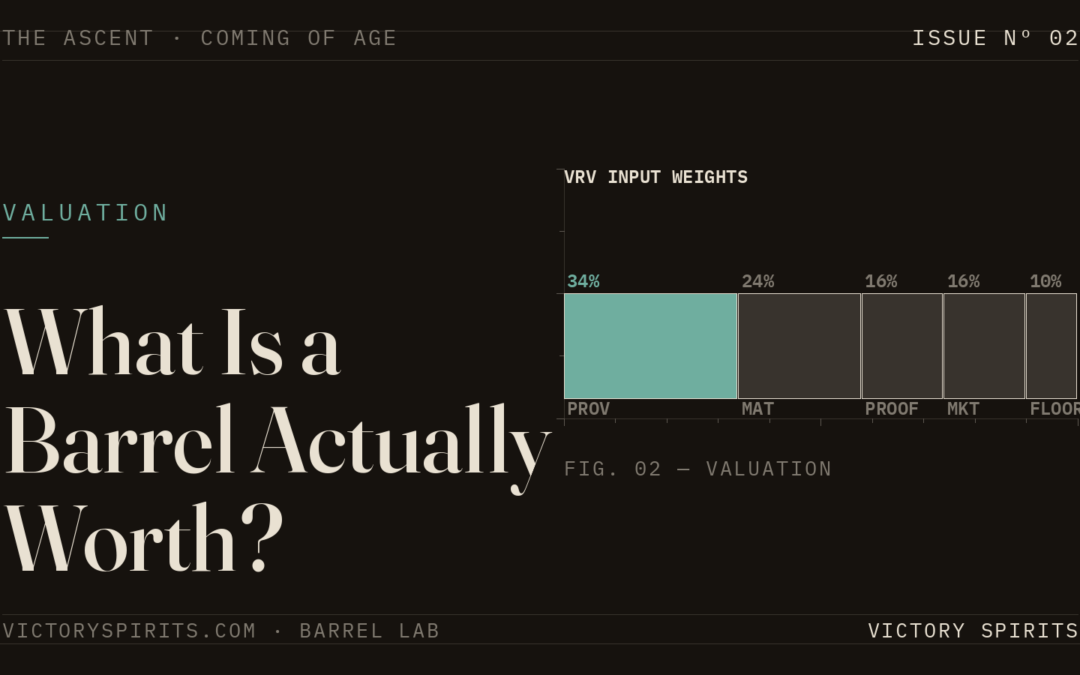
Provenance. Who distilled it, on what mash bill, at what plant. This is the single largest lever and the one most corrupted by claims that cannot be verified. A confirmed eight-year from a known producer is a different asset than an “eight-year, trust me.”
Maturity. Not just age in years, but the shape of the maturation curve. The value a barrel gains per year is not linear — the move from four to five years is not the move from eight to nine — and a valuation that treats age as a straight line misprices most of the inventory in the market.
Proof and yield. A barrel is sold by the proof gallon, not the unit. Two otherwise identical barrels at different proofs are not the same quantity of sellable spirit, and a price that ignores this is comparing things that are not comparable.
The market signal. What comparable inventory is being offered at right now, across the brokers and platforms where it surfaces. Not one whispered comp — the weight of the visible market, aggregated.
The cost floor. What the spirit costs to replace or carry. Value cannot durably sit below it, and a reference number that ignores the floor will get arbitraged the moment it does.
None of these is a secret. What has been missing is not the inputs. It is the discipline to combine them the same way every time, so that two people pricing the same barrel arrive at the same number.
A reference value is a method, not an opinion
This is the heart of it. A trustworthy barrel valuation is not a smarter guess. It is a method — a fixed procedure that takes the drivers above, weights them deliberately, and produces a number that can be reproduced, audited, and argued with. The number’s authority comes from the fact that it does not change based on who runs it.
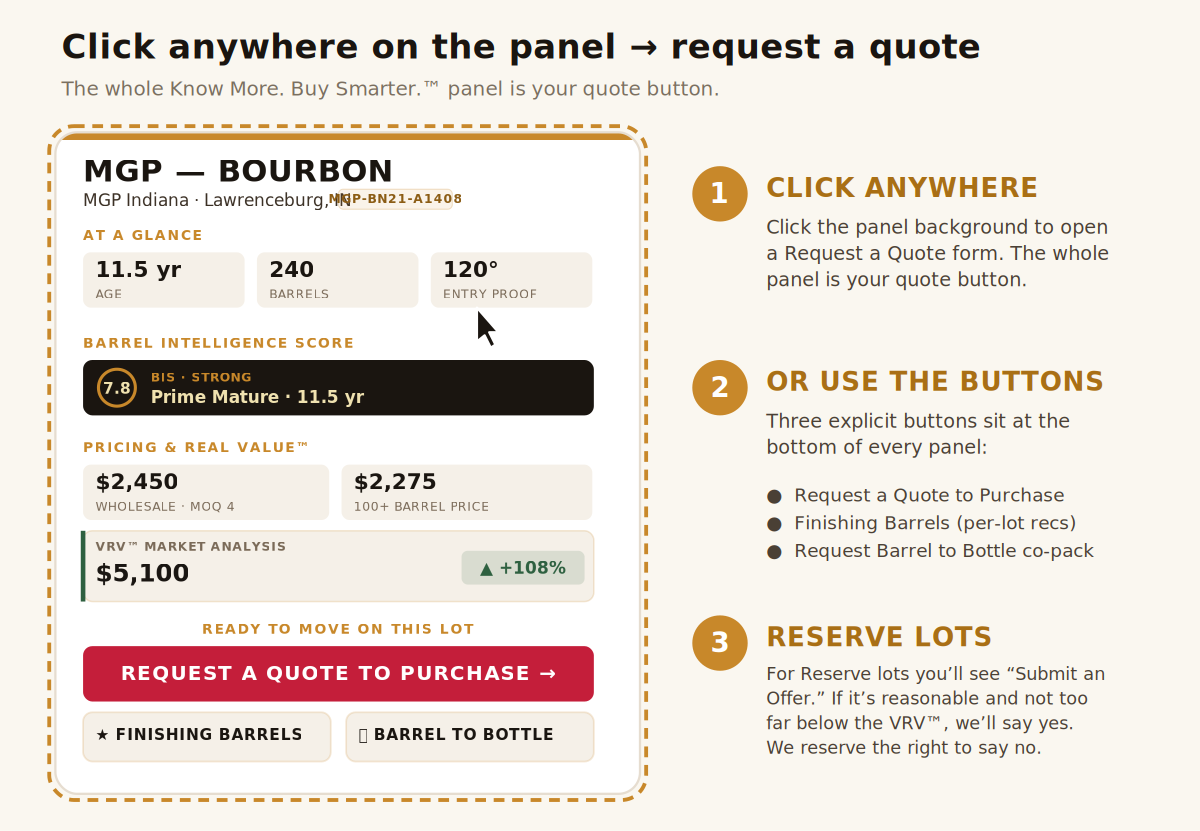
That is what a reference value is in every market that has one. Blue Book is not a person’s opinion about your car; it is a method applied to make and model and mileage and condition. The method is the product. Its credibility rests on two things: that the inputs are real, and that the weighting is consistent. Get those right and you have something this market has never had — a neutral number all three people on the phone can check their position against.
This is the work behind what we call the Victory Reference Value. We are not going to pretend the weighting is obvious or that it fell out of a spreadsheet on the first try; calibrating how much maturity should count against market signal against the cost floor is the hard part, and it is the part that earns trust slowly, one transaction at a time. A later issue in this series will take up the harder question of how much of that methodology a reference layer should make public — because transparency builds credibility and also invites imitation, and that tension is real.
Why this is the precondition for everything else
A legible price is not one feature among many. It is the thing the rest of the market organizes around. You cannot have honest provenance premiums without a baseline to add them to. You cannot share the excise economics of a deal if the deal’s price is itself a mystery. You cannot let an emerging brand source its first barrels with confidence if “what is this worth” has no answer it can trust.
Price discovery is the foundation. Build it correctly and the asymmetry that has defined this market for its entire history starts to close — not because anyone was forced to be honest, but because the number is finally on the table where everyone can see it.
That is what a barrel is worth: exactly what a consistent method says it is, applied the same way every time, in full view. The market has run a long time without that number. It will not run much longer.
The Ascent — Coming of Age. A bi-weekly series on the structure and future of the bulk whiskey market, from the team building Victory Spirits Barrel Lab.